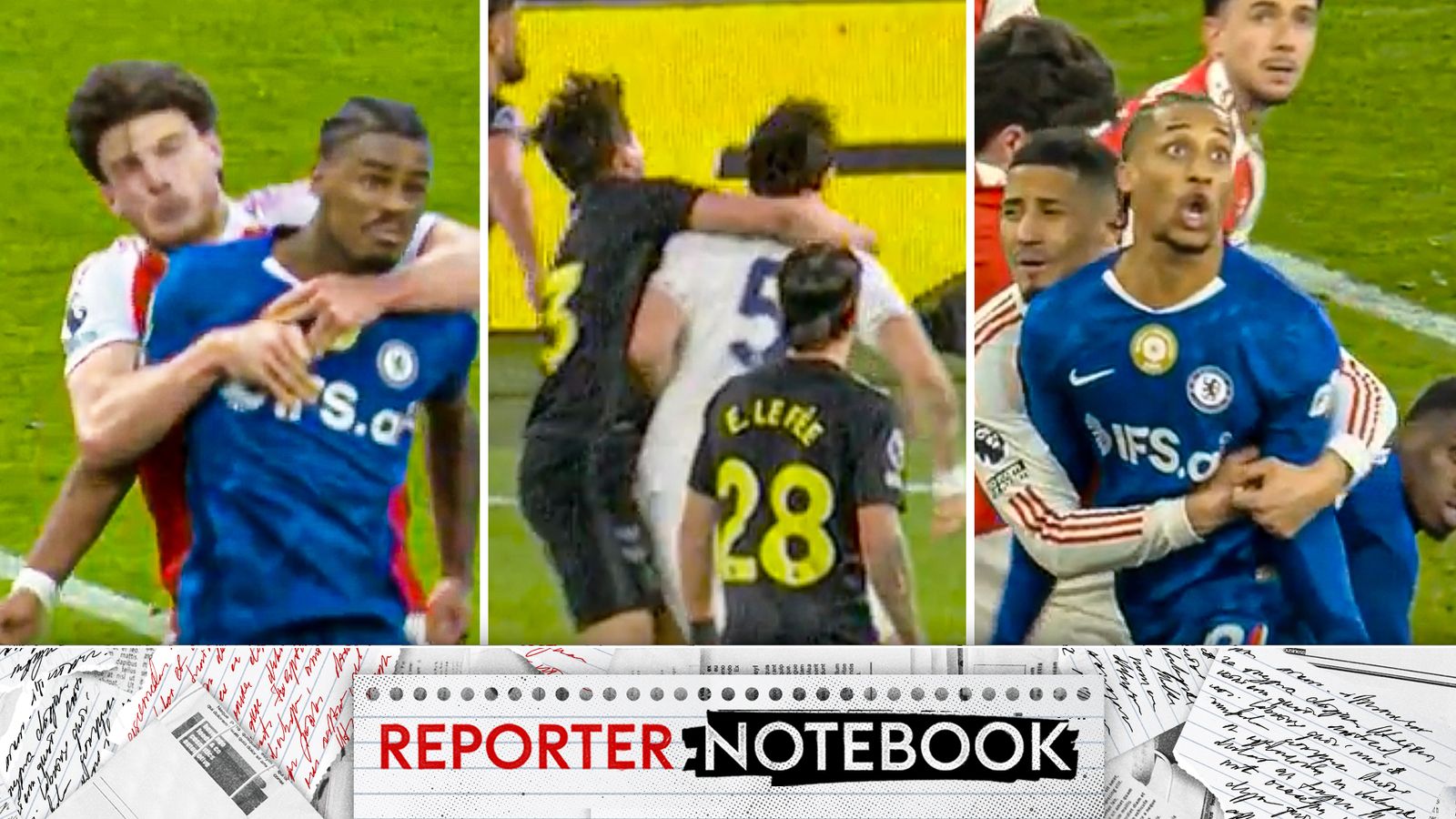
There has been a significant increase in the number of penalties awarded in the Premier League for shirt pulling or holding, Your Site News can reveal.
The statistics show that up to match round 28 last season, four penalties had been awarded for holding at set pieces compared to seven at the same stage this season.
If you include the number of penalties given for holding offences in open play (when a cross comes into the box), there has been a total increase from nine penalties by this stage last season to 12 penalties so far this campaign.
There is no more contentious topic in English football right now than the one around grappling and holding in the penalty area. The issue often dominates managers' post-match news conferences and supporters' opinions.
Most recently, after Pascal Struijk hit the ground under the challenge of Sunderland's Luke O'Nien, the Leeds boss Daniel Farke was asked whether he thought it should have been a penalty. "It is not even a question," Farke said. "What was VAR doing in this scene? It can't be a clearer penalty."
The answer, for Farke and all of football, was that the VAR was trying to quickly assess whether a clear and obvious error had been made with the on-field decision, in what is singularly the most subjective area of refereeing. That doesn't mean the officials got the final decision right.
At the start of this season, the head of referees Howard Webb provided new guidance for managers, players and fans on how grappling would be refereed in the upcoming campaign.
Every summer, the Premier League and PGMO carry out an extensive survey of key people from different areas of the game to get feedback on what their refereeing priorities should be. Managers, captains, other referees, pundits and supporters groups are all asked for their opinions. Overwhelmingly, I understand, there were three priorities which were repeated over and over again - people in the game want a high threshold for handball, a similarly high threshold for VAR intervention and for physical contact.
That shouldn't come as a surprise - the physicality of the Premier League is one of the factors that sets it aside from the other big five European leagues, and which makes it the envy of the world. And so, if referees are told that two of their three priorities are to allow a decent chunk of physical contact in the game, and that there should be a lightness of touch when it comes to VAR, it is totally understandable how we have reached the situation we now see match-by-match in the Premier League, where a great deal of shirt pulling and physical blocking goes unpunished.
However, in August, Webb said that there would be a measured crackdown on holding in the box. "The feedback that we had is that there are just a few too many examples of players clearly pulling people back, impacting their ability to move to the ball, or some clear extreme actions are not being penalised," said Webb. "They're the ones I expect us to catch. Therefore, I would expect this time next year for there to have been a few more penalties given for holding offences than what we've seen this year. But not a huge swing of the pendulum."
So far this season, there have been seven penalties given for holding/grappling in the box - a 75 per cent increase on last season's total at this stage. That was predicted by Webb before the season even started: "If we went in like a steam train and gave every little bit of sort of contact then….we would get told very quickly to ease off from what we're doing. We have to take the game with us and we have to be credible."
A penalty should be awarded if the holding/grappling is "clear, impactful and sustained" - if one of those factors is not evidenced, the officials should not give a penalty.
But the key factor to remember here is that penalties awarded for holding are subjective refereeing decisions, and the VAR dictum (supported by the pre-season survey) is for a lightness of touch - the VAR should only get involved if there is a "clear and obvious error".
What is difficult to comprehend as football fans is that the VAR might think a foul has occurred and that a penalty should have been awarded by the on-field referee. But unless the decision of the referee reaches the threshold of a "clear and obvious error", the VAR will not intervene. The alternative is for the VAR to re-referee the game, which is something everyone in football agrees should not happen.
The problem with holding/grappling is that it is very difficult for there to be consistency across refereeing decisions. How do officials fairly and accurately distinguish between what is "permissible contact" and a level of contact which should be penalised? If an attacker's shirt is being pulled, how long must it be pulled for before the referee decides it is sustained?
It is an important principle of British football that it remains a contact sport, that not every point of contact between players is a foul. That leads to an inevitably grey area.
As we have discussed, the new guidance allows for referee discretion, as the officials look to assess how severe the holding may be. Criteria a referee is expected to consider include: the length of time a player is held for; the extent of the impact on their ability to move; the nature of the opponent's efforts to impede movement; whether both arms are being used.
But again, there is nothing in the laws of the game or the contemporary guidance for referees that says, 'if a player's shirt is held for two seconds or more, you should award a penalty'. There is no defined timeframe.
Furthermore, if a corner or free-kick has not yet been taken, any grappling in the box at that point as players line up, cannot lead to a penalty - the referee can only award a penalty once the ball is back in play. As a result, if an attacker is thrown to the ground before a corner is taken, the referee's only course of action is to warn the player/s involved, or deliver a yellow or red card.
It is very clear to everyone watching the Premier League this season that all teams are testing the grappling rules to the full. Coaches and players will always seek to gain the maximum advantage that they can within the rules, and it certainly seems that players are looking to exploit the vagaries of the rules in this area. We are seeing more incidents where defenders are grappling and holding for sure, but we are also seeing more incidents where attackers at set pieces are exaggerating contact too, appealing for a penalty.
In Leeds' match against Sunderland on Tuesday night, we should make it clear that there is no suggestion Struijk was guilty of "simulation", as that offence is outlined in the rules. In fact, it is clear from the pictures that O'Nien was the wrong side of the attacker and had his hands on Struijk's neck and shoulders as the Leeds man made an attempt to get to the cross.
So why didn't the VAR intervene?
Most commentators would argue that they should have. But it could be argued that O'Nien's contact wasn't enough to force Struijk to the ground, and if the VAR felt that, it may offer mitigation that suggests maybe the contact wasn't sustained. If that was the VAR's interpretation, they might well feel there was no "clear and obvious error" on the part of the referee. But it is definitely a moot point, and highlights again how subjective and problematic the issue is.
There will be no change to the rules or to the guidance for match officials for the remainder of this season. The Premier League and PGMO stick to the principle that they are opposed to rule changes mid-season.
The International Football Association Board can only change the laws of the game once a year, at its AGM. That meeting happened in Wales last weekend, and the issue of grappling/holding was not discussed.
And so the next opportunity for there to be new guidance for referees in England will come in the summer - before the start of the next domestic season, and when the next survey of football's participants has gathered feedback on the issue.
Before then, we have the World Cup. And it is very obvious that grappling and holding is refereed differently in different parts of the world, and even within different European leagues. FIFA makes sure that each nation is visited by a refereeing official before the start of each tournament, where a detailed explanation is given to players and coaches about how the rules will be interpreted. Judging by the current trends, it is much more likely that penalties will be awarded for holding in the penalty box during set pieces in the USA, Mexico and Canada than we are currently seeing in the Premier League.
To some, that will be good news. To others, it will be the exact opposite.